
Wood Repair for your Home

Wood repair for your home – Windows, Doors and Cladding

If you have exposed wood on your house, eventually you will probably experience some degree of wood rot.  Wood only needs warmth and moisture to begin turning into a deteriorated mess.  As a home owner you should check any horizontal areas which may collect water with an awl or metal probe.

Even a well-maintained home can develop problems with rot. Rot is caused by wood absorbing water, and there are a wide variety of causes, such as poor circulation, poor drainage or improper sealing.  If you have rotted wood, be aware that it has to be repaired or replaced to prevent water, air and/or bug infiltration into your home. Wood trim in Ontario should be cleaned, caulked and re-painted every four to eight years depending on its condition.  If the wood is not painted regularly, the paint will fail and the wood will not have any barrier to the elements and will soak up water. If it’s not regularly painted, then you can “pay me now or pay me a lot more later.”

There are many methods of repairing rotted wood surfaces.  The number one priority is to remove all rotted wood with a sharp tool ensuring no soft wood is remaining.  Failing to remove rotted wood can lead to rot continuing to damage remaining wood under repair.

There are many products available to repair rotted wood on the exterior of your home..  Some of the more popular methods are covered below:

One common repair method is using a polyester filler which can be shaped and moulded to fill removed areas of rotted wood.  Sanding can match existing  profiles and paint will make repair look like new.

Epoxy fillers are a structural adhesive putty and wood replacement compounds. They are a high-strength no-shrink adhesive paste to fill, repair and replace wood and other materials in structures, walls, floors, furniture, sculptures. They are unaffected by water and insects.  . Epoxies must be mixed with their catalyst to become chemically active, so you have a limited amount of time to work with epoxy before it begins to harden. Heat makes epoxy cure faster, so you should take the weather into account when making repairs.
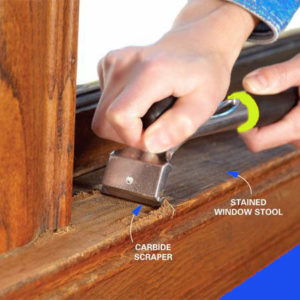
Wood Trim Repair

Interior surfaces made from wood need to be kept clean at all times to prevent damage. Fixing problems such as dings, cracks, and scratches on wood trim can be a simple task. If part of the surfaces seems to be seriously damaged, you may want to consider replacing the trim rather than repair. Otherwise, you can hide or cover up gouges and minor scratches with the right materials. But first, you have to clean the surface to get rid of the grime and grease.

You can repair wood surfaces with epoxy filler or wood putty, depending on the extent of the damage. Use epoxy filler if the damage is extensive. For cracks and dents in your trim molding, you can use wood putty. Soft wood putty is perfect for filling holes left by screws and nails, and it’s easy to apply. All you have to do is fill the putty into the damaged area and wipe off with your finger. You don’t even have to sand it.

Clean the area to be repaired to remove any grease and dirt. Use masking tape to protect your walls. Using fine grit sand paper, sand off any raised edges or splinters. Next, apply wood filler over the damaged area. If using wood putty, it will shrink as it dries and any excess can be sanded off after it dries. Allow it to dry completely overnight. If using epoxy, be as precise as possible and be careful not to use too much as it will not shrink and is more difficult to sand. After it has dried, sand it smooth and clean off the dust. If you are painting it, apply primer first, then paint.

How Long will your Home Last?

Tips on Staining your homes Deck.

Some homeowners are using Fake Grass

When buying an older home with exposed wood trim protect yourself and your investment by having your property inspected by Barrie Home Inspections

Repairing Concrete Foundations

Repairing Your Homes Concrete Foundation
 
Concrete foundations are of two types – poured concrete and concrete block. Poured concrete is a modern manner of laying foundations, while concrete blocks are more traditional. Concrete blocks are preferred for their visual appeal and strength. Yet, as time passes, there may be degradation of concrete.

The prime cause of cracks in concrete foundation is seepage of water. Such cracks caused due to leakage of water are thin and hairline. They may widen over time, but they are present only in those areas where the seepage occurs. In order to repair leakage cracks, it is necessary first to investigate the source and the point from which the leakage originates. There may be other reasons for concrete foundations to crumble. Soil may lose its moisture content in summer. There may be underground roots which may wither and die. Such natural causes make the soil shrink and hence the foundation may move. Though this movement is gradual, overtime it will cause cracks to occur. These cracks will be large gaping ones, running across the entire length of the foundation. They may even be in the form of tiny holes in certain places. Whatever be the reason, cracks in the foundation are very perilous if ignored. Repair must be done as soon as possible.

Difficulties involved in the repair process are influenced by how big the cracks are. For tiny moisture created cracks, the repair is relatively simple and can be done by almost anyone. These cracks must first be brushed clean with a wire brush. A jet of water may be passed to remove any loose concrete particles within the crack. The crack is then allowed to dry completely and filled with concrete caulk. If the crack is large, then it is packed with patching materials that are specifically available for concrete. These patching materials must be wet when applied. They are limestone based, and they expand as they dry, filling up the crack completely. The finishing touch is to apply a sealant to the repaired crack. But if the crack is sinister and not the do-it-yourself kind, then it is most prudent to shell out a few dollars and hire some good repairmen. Such cracks occur due to rods which may have rusted inside and snapped or because of deterioration of the materials present within the concrete.

Some leakage cracks when ignored can also reach dangerous levels. Such cracks are more found in poured concrete. Contractors treat the concrete foundation with urethane injections to extract the embedded water. They may even excavate the area around the foundation and replace the faulty tile or construct a provision for the water to lose contact with the foundation.

Foundation Repair
The principal function of a foundation of a home is to transfer the weight of a structure to its underlying soil and rocks. One of the factors that bring about the need for foundation repairs is improper foundation settling. Foundation settlement can devalue structures and also render them unsafe. Building on expansive clay, compressive or improperly contracted fill soils and improper maintenance in and around foundations are some of the major reasons of improper foundation settling. Another reason for improper foundation settlement is undetected or unsuspected air pockets in the ground below the area of construction. These may cave in and cause the integrity of the foundation to be compromised.

General symptoms of a structure needing foundation repairs are bulging or cracked walls and doors that don’t close properly. Building on expansive soils is the main culprit for foundation settlement. When only one part of the foundation either settles or heaves, cracks are formed in the foundation.

The exterior warning signs of improper floor settling are rotation of walls, displaced moldings, cracked bricks and foundation and separation around doors and windows from the walls.

Interior warning signs of improper floor settling are cracks on the floor, sheet rock and misalignment in doors and windows. There are many ways of doing foundation repair. Cement, stone, steel or wood were used extensively in past techniques. They would be forced into the ground in a bid to salvage the strength of these foundations. However, this type of repair work has been known to be futile.

Two of the most successful ways of foundation repairs are slab jacking and the Piering method. Piering is also known as hydraulic jacking. Slab jacking is the process of adding grout beneath a slab or beam. This produces a lifting force and restores the said beam or slab to almost its original elevation and adds to its strength. Care should be taken that the amount of sand should be perfect while adding grout. During Piering, steel posts are driven through unstable soil. Hydraulic jacks are used to stabilize concrete slabs which are weakened due to the changes taking place in the underlying soil. Steel beams are used in the Piering method because concrete has great compressive strength. Though Piers are able to transfer huge downward loads without the help of reinforcing steel, steel is used in the piers for prevention of the pier from being pulled apart or sheared by forces of the expansive soils. The repairs normally take 21 to 30 days, however this time frame can vary depending on soil conditions and weather delays. This article is for general knowledge only, always consult with an expert regarding any structural design issues or faults.

The Barrie Home Inspector has inspected over 8,000 foundations.  For more information on foundations or water penetration visit blog on home maintenance and tips.